After the stock market rally in the first half of the year and amidst the uncertainty of the upcoming election, for assets without tax implications, we are reducing risk by trimming some of the overweight for our active positions. While still in gear, we are lifting our foot from the gas pedal, still preferring stocks over bonds and select areas of risk. Seasonal weakness leading up to the election is the catalyst for us to down-size some of our bets and take gains off the table. 


While we believe large cap, growth, and US stocks will continue to outperform, we are reducing our equity overweight to 1% relative to fixed income, down from a prior 4% overweight earlier in the year. We still maintain our exposure to tech and the highest earners in the market but are proceeding with caution. Historically, financial markets regularly see a rise in volatility in October. This increase in volatility is especially pronounced in presidential election years; providing further support for pruning risk in early September. 


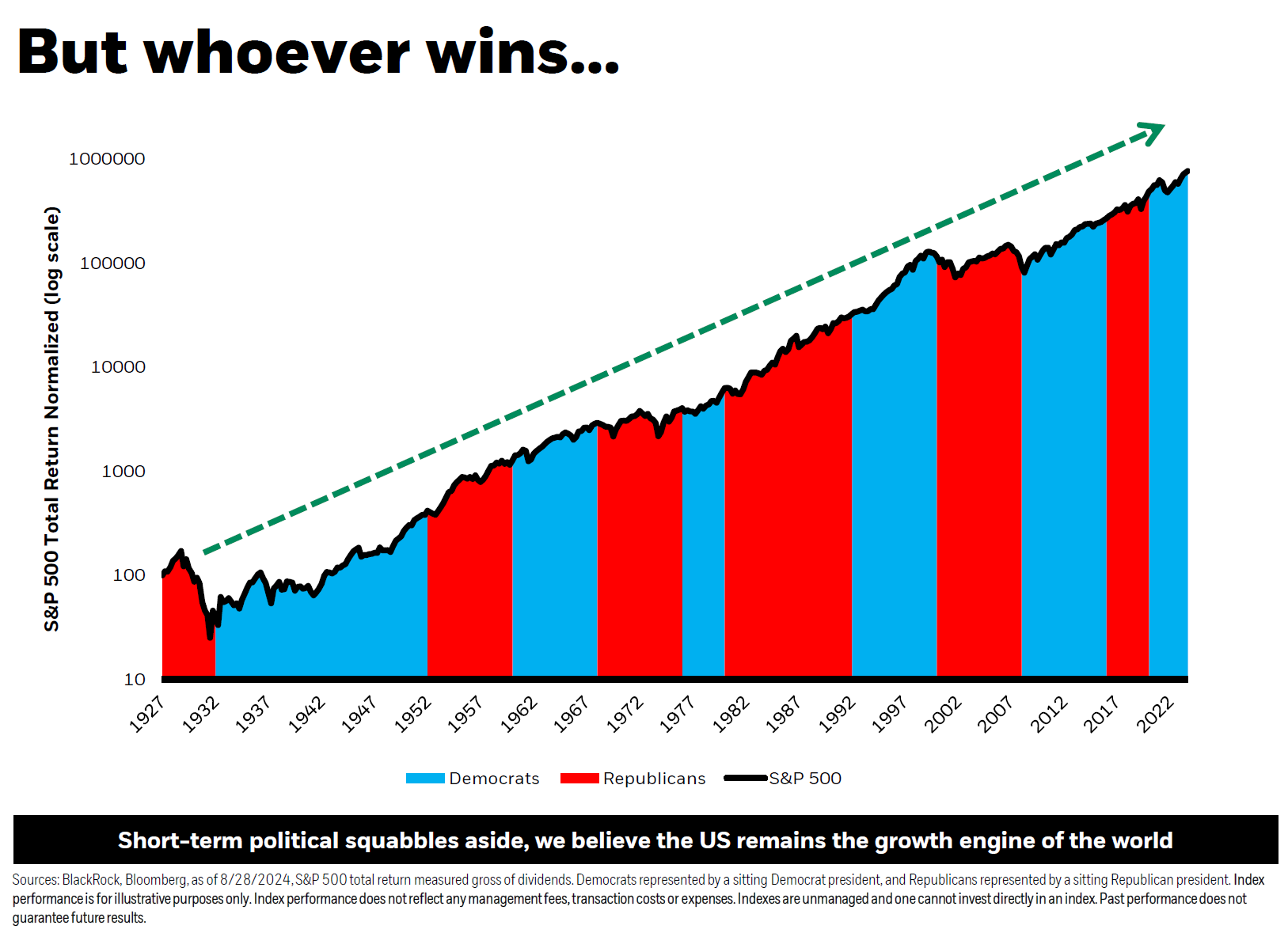
As part of our March rebalance, we discussed the bullish tailwinds we saw in the market. In June, we doubled down on the momentum. So far, the conviction has paid off, as 2024 has been a positive environment for stocks. We are taking a pause during a historically weak period with elevated risks. Assuming we have a successful election, we expect that markets will move on regardless of which party is in the white house.


Bar chart in red and blue with upward trend line, titled “But whoever wins...”

Earnings have been relatively strong, yet not extraordinary this season. An unprecedented presidential contest, Fed moves, and recent volatility indicate that from here until November, there lies a path ridden with unknowns that the market will have to digest. We are trimming our US exposure due to these factors, moving closer to the benchmark on international exposure. Within our international exposure, we are also adding to developed market stocks to move closer to benchmark as part of our move to take risk off the table. We also continue to tilt into emerging markets stocks, yet continuing to exclude China.


In early 2024 we stated that we were positioning assets for multiple rate cuts in 2024. Markets have come around to that view, and we are still anticipating more cuts by year end. Historically, when the Fed cuts, there are two types of outcomes for stocks. The first is when there's a recession in the next twelve months, and stocks don't do extremely well. They still tend to have somewhat positive returns, but it’s appropriate that recessions cause underperformance. The second type, if the Fed cuts and there’s no recession, that’s typically fuel for stocks over the next twelve months. Lower borrowing costs and easier monetary policy are unsurprisingly a boon for business.
 
We find the second scenario to be more descriptive of the current macro environment. The uptick in unemployment and triggering of the
Sahm rule make for good headlines, but the current labor softening is primarily driven by expansion of the labor supply rather than job loss. Layoffs are still at historic lows. There would need to be substantially more softening to trigger a recession. Either way, we are cautiously bullish over the next year. 80% of the last 20 Fed cutting cycles have led stocks higher. This gives us reason to hold some of our overweight exposure to stocks and wait for the right entry point for more if we see firms benefiting from a higher liquidity environment.


Shifting from stocks to bonds, we are trimming holdings on either extreme of the curve. Inflation nearing official targets paired with softening in the labor market gives the Fed enough ammunition to embrace a dovish narrative and hint at a stark change in rate path. Our long-duration trade finally paid off as the recent bond rally priced in aggressive Fed cuts in the coming months. We are trimming that position and moving duration towards the belly of the curve.


We continue to provide these ongoing updates on our views and investment positioning through posts like this. If you have any questions about our investment strategy, please let us know and we will make sure to review details at our next meeting. While we don’t recommend fixating on short-term market fluctuations, if you would like to check specific investment performance across all your accounts, our online Orion Portal is available 24/7.


Thank you for your continued trust and allowing us to coordinate asset management as part of our Family CFO services! 

Recent Buttonwood Articles


Child placing coins into a piggy bank while learning about saving and financial responsibility.
By Danielle Brown, CFP MSF July 7, 2026
What families should know about Trump Accounts eligibility, contributions, financial literacy. Child investment accounts may fit in broader financial plan.
By Jon McGraw July 1, 2026
Beyond fees, DIY investing carries hidden costs — time, taxes, and coordination. A Kansas City wealth management perspective on when self-directed makes sense
SpaceX and Anthropic are filing for the two largest IPOs in history. Learn how index fund exposure,
By Kristy Wieland June 10, 2026
SpaceX and Anthropic are filing for the 2 largest IPOs in history. Index fund exposure, 401(k) passive buying, and mutual fund holdings mean you may already own them
Historic street scene with people gathered around a table outside a brick building at dusk.
By Kristy Wieland May 16, 2026
The Buttonwood Agreement: Where American Finance Took Root — and Why Our Name Exists The Buttonwood Agreement was a compact signed on May 17, 1792, by 24 stockbrokers and merchants beneath a buttonwood tree at 68 Wall Street in New York City. It established the rules of organized securities trading in America and laid the foundation for what would become the New York Stock Exchange. Buttonwood Financial Group takes its name directly from this founding moment; as a daily commitment to the integrity, transparency, and long-term thinking those original brokers put on paper. What was the Buttonwood Agreement, and why it still matters The Buttonwood Agreement came at a moment of crisis. The Panic of 1792, America's first speculative bubble and market collapse, had shattered public confidence in capital markets. Prominent financiers defaulted. Prices fell. Investors panicked. Alexander Hamilton worked to stabilize the system, but the lasting fix came from the professionals themselves. On May 17, 1792, 24 brokers gathered under a buttonwood (sycamore) tree outside 68 Wall Street and signed a two-sentence agreement: they would deal only with each other, charge a standard commission of one-quarter percent, and give preference to fellow signers in all negotiations. Simple. But the effect was transformative. By agreeing to hold a higher standard collectively, they rebuilt confidence in the market itself. The Buttonwood Agreement is widely regarded as the founding document of the New York Stock Exchange and of organized American finance. Why Buttonwood Financial Group carries this name Boutique wealth management firms are built on process and trust. When we named our firm Buttonwood Financial Group, the choice wasn't aesthetic; it was philosophical. Our name is a daily accountability measure; a reminder that the values those brokers signed onto in 1792 — integrity, structure, and responsibility — are exactly the values our clients deserve today. The families and individuals we serve aren't looking for surface answers and financial products. They're looking for an experienced team that has been tested across market conditions, that communicates honestly, and that approaches every client relationship from a fiduciary capacity in a long-term commitment. That's what an established boutique wealth management firm looks like in practice. What experience really means Experience in this industry isn't about credentials alone. It means you have been present with clients through market downturns and periods of uncertainty. You have worked alongside families through estate complexity, business transitions, and inheritance conversations. You have coordinated tax strategy, cash flows, and generational goals at the same time; because for most families, those things can't be separated. Our Team brings that depth to every engagement. Not because we're proud of our tenure, but because the people we serve deserve to work with real people whose judgment has been informed by real world complexity and a wide range of client circumstances. The values that haven't changed in 234 years The Buttonwood Agreement was forged in a crisis to restore confidence. That context mirrors what many clients feel when they first reach out to a firm like Buttonwood. The financial world is complex, opaque, and hard to navigate. Our commitment is to bring transparency, fiduciary responsibility, and honest communication to every relationship, the same values those brokers enshrined in 1792. Roots matter. They tell you where a firm stands when things get hard. On Buttonwood Agreement Day, we honor that founding moment, and recommit to carrying it forward. Connect with Buttonwood Financial Group If you're evaluating whether your current wealth management relationship reflects these values, we'd welcome the conversation. Our advisors work with individuals, families, and business owners on comprehensive, fiduciary-driven financial plans built around your long-term goals. Frequently Asked Questions What is the Buttonwood Agreement? The Buttonwood Agreement was a compact signed on May 17, 1792, by 24 stockbrokers and merchants in New York City. It established standardized rules for securities trading, dealing only among members, and charging a fixed commission. It is considered the founding document of the New York Stock Exchange. When is Buttonwood Agreement Day? Buttonwood Agreement Day is observed annually on May 17, marking the date the original agreement was signed in 1792 outside 68 Wall Street in New York City. Why is the Buttonwood Agreement significant in finance? The Buttonwood Agreement replaced chaotic, unregulated securities auctions with a system of structured, trust-based trading. It restored public confidence after the Panic of 1792 and established the foundational principles, integrity, accountability, and standardized commissions, that governed Wall Street for nearly two centuries. What does Buttonwood Financial Group do? Buttonwood Financial Group is an independent SEC Registered Investment Adviser. A boutique wealth management firm. The firm works with individuals, families, and business owners to provide both financial planning and investment management services. By serving as the primary financial advisor and administrator, Buttonwood is essentially acting as the family's "CFO" while the client remains as the family "CEO." Buttonwood strives to organize, formalize, implement, and monitor financial strategies consistent with clients' multi-generational goals and objectives. What makes a boutique wealth management firm different? Boutique wealth management firms typically offer more personalized service, deeper advisor relationships, and a fiduciary-first approach. Advisors and their support teams generally work with fewer clients and provide more integrated guidance and may reach a deeper level of strategy across investments, tax, business and estate planning, and financial planning. How do I choose an experienced financial advisor? We often see the following criteria: Look for advisors with a fiduciary obligation, verifiable credentials (CFP, CFA, or similar), a transparent fee structure, and experience working with clients whose situations are similar to your own. Confirm the advisor's registration status at adviserinfo.sec.gov. B uttonwood Financial Group is a registered investment adviser. The information provided in this article is for general informational purposes only and does not constitute investment, financial, tax, or legal advice. Past results are not indicative of future performance. All investing involves risk, including possible loss of principal. Please consult a qualified professional for advice specific to your situation.
When is the last time your financial advisor called you
By Jon McGraw April 29, 2026
What Should I Do With My Investments During Market Volatility? During periods of market volatility, the most important step you can take is to stay grounded in your long-term strategy. Ironically, reacting emotionally to short-term developments; whether they be tariff rulings, geopolitical escalation, or interest rate speculation, have historically introduced more risk than the volatility itself. A relationship with a fiduciary financial firm can help you maintain discipline and perspective when headlines make that difficult. Why Are Markets So Volatile in 2026? If the first few months of 2026 have felt turbulent, you are not imagining it. After a historically strong 2025 that included dozens of record closing highs in major U.S. indices, investors entered this year with elevated expectations. Several developments have since introduced meaningful uncertainty, and the markets don’t like uncertainty! In February, the Supreme Court ruled that broad tariffs enacted under the International Emergency Economic Powers Act exceeded executive authority. The ruling reduced some trade policy ambiguity, but a new set of tariffs was promptly announced under a separate legal framework, leaving businesses and investors still navigating an evolving landscape. Separately, geopolitical conflict and rising energy prices have added pressure to an already cautious global outlook. Meanwhile, expectations around Federal Reserve policy continue to shift as new leadership takes the helm. Markets are currently pricing in potential rate adjustments later this year, but the path forward depends on a wide range of economic data that remains unsettled. Perspective matters: Market pullbacks are a normal and recurring feature of investing. Looking back over the last 50 years, the S&P 500 has experienced an average intra-year decline of about 14%. However, in 35 of 46 calendar years, the index ended in positive territory . Past performance is not indicative of future results, but the historical pattern is worth understanding. What Should You Consider Doing With Your Investments? Should I sell my investments during a downturn? Selling during periods of elevated volatility can feel like the safest decision, but it often locks in temporary losses and creates a new problem: deciding when to reinvest. Markets, forecasting the trajectory of the companies that make them up, have historically recovered from pullbacks, sometimes quickly and unexpectedly, and investors who moved to the sidelines have at times missed meaningful rebounds. That said, every situation is different, and decisions should be grounded in your unique circumstances. How do I know if my current plan will still work? Well-constructed financial strategy is built to account for periods of uncertainty. If your plan was designed around your specific objectives, your time horizon (your generation or multigenerational), and a realistic range of market scenarios, short-term volatility does not necessarily mean your plan needs to change. That said, life circumstances evolve, and market environments like we are experiencing in 2026 can be a useful prompt to review whether your financial strategy still aligns with where you are today. This is a conversation your team should be proactive about initiating. What does rebalancing look like in a volatile market? Volatility can cause your portfolio to drift away from its intended allocation. Rebalancing is the process of bringing it back into alignment. With the general assumption the economy grows ¾ of the time, market dislocations often create opportunities to rebalance at favorable levels. A rebalance might involve adjusting between asset classes, revisiting diversification across geographies and sectors, or reviewing fixed income positioning in light of changing interest rate expectations. Rebalancing is a disciplined process, not a reactive one, and it should be guided by your overall financial strategy rather than by today's headlines. Why Does an Independent Fiduciary Advisor Matter? A financial advisor electing to serve as a fiduciary is legally required to act in your best interest at all times; not their own (for compensation) or their employer’s. This is a higher standard than the suitability standard that governs many broker-dealer or hybrid relationships. Independence matters alongside the fiduciary standard. An independent firm can be broadly defined as not being owned by a bank, insurance company, or wirehouse. When a firm is independent, there is a lower probability you will receive biased recommendations influenced by proprietary product limitations, corporate sales quotas, and pressures to recommend one strategy over another for reasons that don’t serve you. In periods of volatility, this distinction becomes especially relevant. At a large firm, your guidance may come from a group of disconnected employees shaped by corporate priorities. At a smaller firm like Buttonwood Financial Group, our Advisors develop and implement strategies in conjunction with our Operations Team. Our output is a financial strategy that is not only customized; the execution of the plan is simplified as well. This happens at Buttonwood because our Team knows you and your family; and our relationship is the foundation of the advice. Buttonwood Financial Group has served Kansas City families, business owners, and high-net-worth individuals for over two decades as an independent fiduciary. Our service models: Financial Advisory, Family CFO, and Family Office, are structured around the complexity of each client’s situation, not around product tiers or asset minimums. Frequently Asked Questions (FAQs and More) What is a fiduciary financial advisor? A fiduciary financial advisor is legally obligated to act in your best interest at all times. This differs from the suitability standard, which only requires that recommendations be appropriate, not necessarily optimal, for a client. How do I find a financial advisor? When evaluating a financial advisor, consider whether the advisor operates as an independent fiduciary, how long they have served the community, whether they offer comprehensive strategy that fits your needs, and whether their team is integrated and has experience with your level of financial complexity. You can verify an advisor’s registration and disclosures through the SEC’s Investment Adviser Public Disclosure database. Should I change my financial strategy because of tariffs? In most cases, a well-constructed financial strategy should not require significant changes in response to any single policy shift, including tariff adjustments. Trade policy is one of many variables that affect markets, and reacting to individual policy headlines can introduce more risk than it mitigates. A fiduciary advisor can help you stress-test your strategy against multiple economic scenarios rather than reacting to any single event. What is unique about an independent fiduciary financial advisor? Independent financial advisors are not owned by or affiliated with large banks, insurance companies, or wirehouses. This independence, in conjunction with a fiduciary standard, helps ensure your advisor recommends products and strategies that serve your best interest. Independent firms also tend to provide more personalized services. What are Family CFO services? Family CFO services provide comprehensive financial strategy and oversight for households and families who need more than Investment management but do not need or want to pay for the staff of their own Family Office. Core Family CFO services include cash flow management, tax coordination, insurance and estate planning coordination and oversight, and support around life's ongoing financial decisions. Our Family CFO Team functions in a similar capacity to a dedicated Chief Financial Officer for your personal financial life. What does a Family Office do? A Family Office provides holistic wealth management for individuals and families with financial complexity beyond our Core Family CFO services. This may include developing and managing advanced investment allocation, tax, legacy planning, philanthropic advisory services, risk management, multigenerational financial literacy, and concierge services. Boutique firms, like Buttonwood Financial Group, offer Family Office services with a dedicated Our Team: Your Family relationship. Let’s Have a Real Conversation If the world seems to be whirling by or you are questioning whether your financial plan is built for what’s ahead, we welcome a conversation: A straightforward discussion about where you are and where you want to go. Important Disclosure This commentary is provided for informational purposes only and reflects general market views as of the date published. It is not intended as investment advice, a recommendation, or a solicitation to buy or sell any security. Asset allocation and diversification do not guarantee profit or protect against loss. Investing involves risk, including the possible loss of principal. Market conditions and investment strategies are subject to change. Please consult with your Buttonwood Financial Group advisor regarding your individual circumstances before making any investment decisions.

Black oil barrel beside stacks of gold coins of decreasing height on a light background
By Jon McGraw April 9, 2026
Oil vs. Gold: What Today’s Market Signals May Mean for Investors

Are you ready to explore the benefits of your very own Family CFO?

LET'S TALK

Buttonwood Services


About Buttonwood Financial Group